PRD-01 · SIMULATION
ASTT
Action Speed Tactical Trainer
Overview
Train the decision, not the interface.
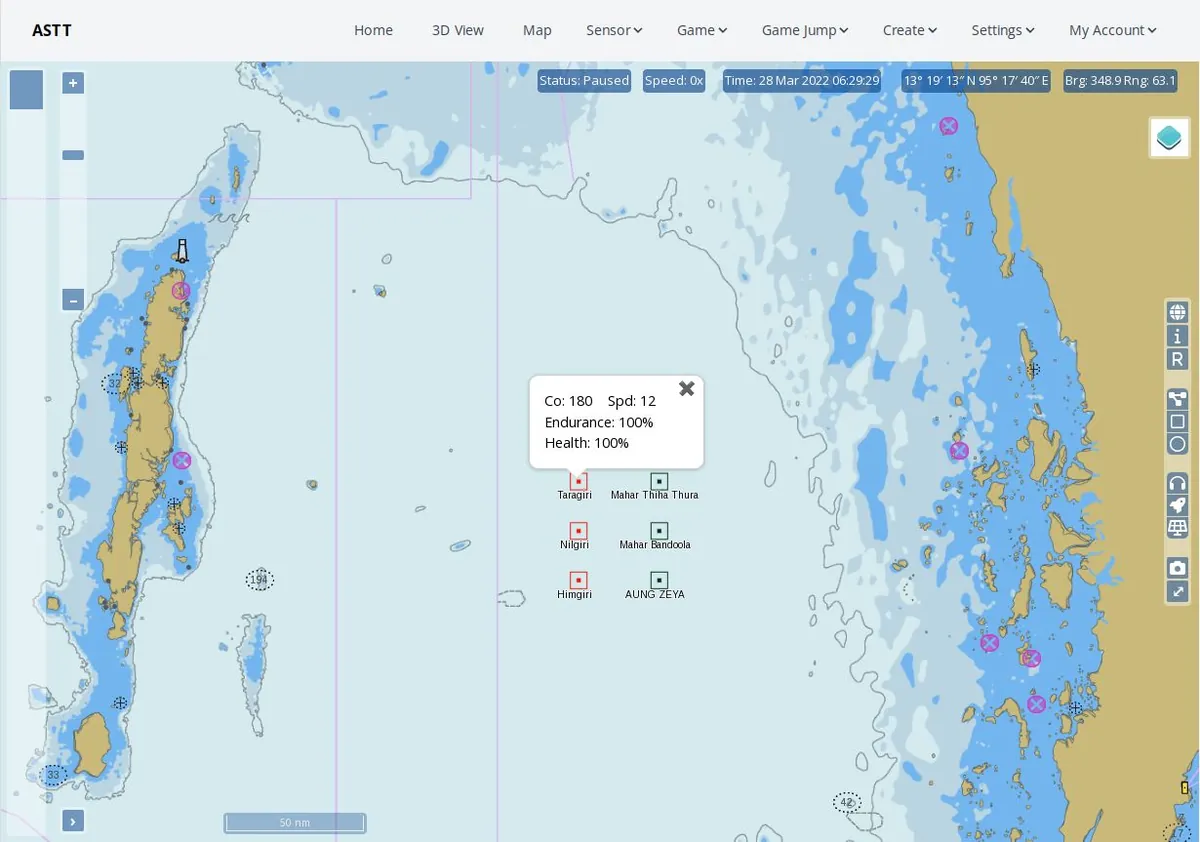
ASTT is a scenario-driven simulation platform that trains operators, watchkeepers and command teams for time-critical maritime and defence missions. Trainees detect, classify, decide and act against a scenario the instructor controls - then review every call they made in after-action debrief. It runs in a browser, which means no client install on a warship's training network.
What it does
Inside the system.
SEN
Multi-sensor simulation
Search and navigation radar, ESM and EW, passive and active sonar, AIS and communications - each modelled against the physics that governs it, not a lookup table.
WPN
Fire control
Missiles, torpedoes and guns, with engagement geometry and time-of-flight that punish a bad firing solution.
ENV
Configurable environment
Weather, sea state and propagation conditions that change what a sensor can actually see.
NET
Single station to multi-cubicle
One trainee at a laptop, or a networked exercise across cubicles with instructor and debrief stations. WAN support brings remote and at-sea participants into the same scenario.
AAR
After-action review
Every contact, classification and engagement is recorded and replayable, so the debrief argues from the track, not from memory.
Under the hood
Engineering depth.
A trainer is only as honest as the model underneath it. ASTT's core is a deterministic multi-domain simulation engine - the same engine that lets it double as an analysis and wargaming tool, not just a training aid.
DET
Deterministic core
The simulation is reproducible by design: the same scenario, run again, unfolds identically. A trainee's outcome turns on their decisions, not on a lucky seed - and an analyst can trust that a result is the model's, not the machine's.
DOM
Air, surface, subsurface, ground
One engine models all four domains with domain-specific kinematics, so a single scenario can run an aircraft, a surface group, a submarine and a shore unit against each other coherently.
LNK
Datalink & track fusion
Network reachability and track fusion are modelled, not assumed: units share the picture only as far as their links actually reach, so the tactical picture degrades realistically when the network does.
MC
Monte-Carlo analysis
Run a scenario once to train, or thousands of times to analyse - batch execution with statistical metrics extraction turns the trainer into a tool for testing a tactic before anyone stakes an exercise on it.
CLK
Live, turbo and replay
A multi-mode simulation clock runs an exercise in real time, fast-forwards a long transit, or replays a recorded run frame-for-frame for the debrief.
CAT
Schema-validated scenarios
Sensors, weapons, platform classes, bases and targets are authored as validated catalogues, so a new force laydown is a reviewed data change - not a code change and not a guess.
Deployment
Where it runs.
On-premise, private cloud, or fully air-gapped. ASTT has no cloud dependency and no telemetry: it runs entirely inside your network.
Start here
See ASTT
against your problem.
Tell us what you're trying to train, track or communicate through and we'll tell you honestly whether ASTT fits - or whether you need something else built.
Start the conversation