PRD-16 · SIMULATION
Undersea Warfare Trainer
Hear it first
Overview
Listen, localise, classify: the undersea fight, trained.
The Undersea Warfare Trainer is a browser-based simulator that trains sonar operators and anti-submarine and mine-warfare crews on a real acoustic model: the water, the layer, the noise and the display. A sonar operator works from sound alone, so it teaches what the displays show, why the sea hides a contact, and which manoeuvre turns a bearing into a position. It covers hull, towed-array, variable-depth and dipping sonars, sonobuoys, magnetic anomaly detection, minehunting sonar and torpedo countermeasures. It is part of the Varuni Simulation Suite.
What it does
Inside the system.
DSP
Read the displays
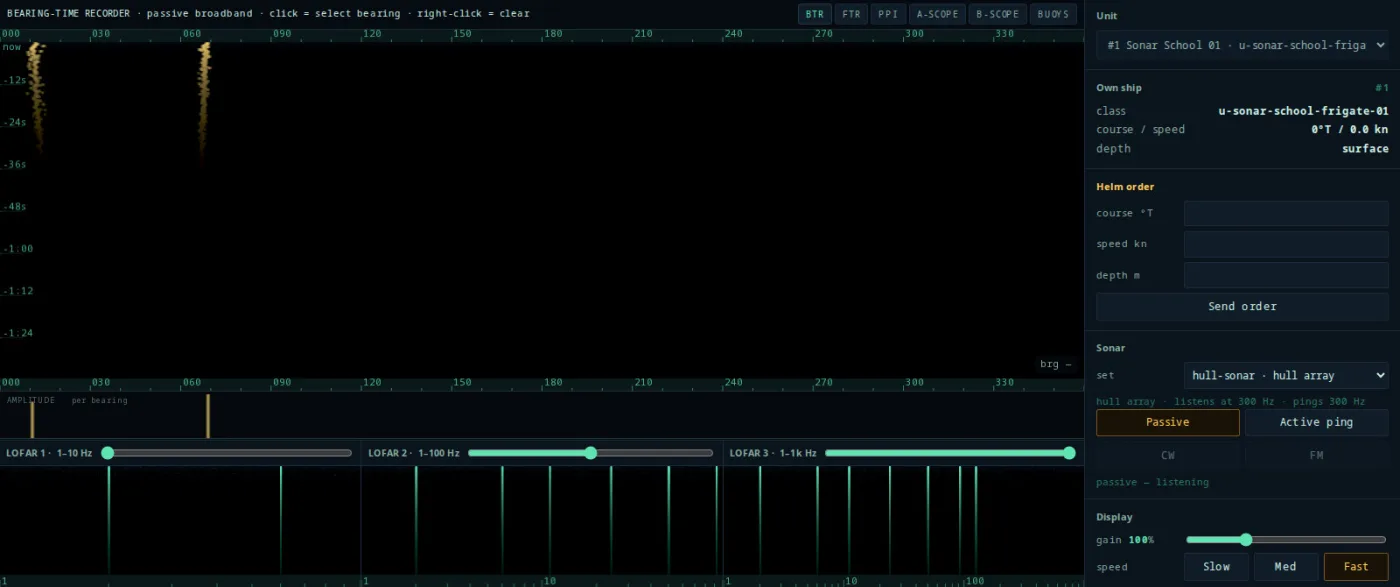
Each display throws away something different. The bearing recorder, the narrowband gram and the polar scope are taught as a set.
LOF
Find a quiet boat
Broadband hides her. Her discrete machinery lines do not, and a narrowband gram integrates on them.
WTR
Know the water
A layer, a sound channel or a seabed decides how far a sound reaches. Range prediction shows it before the search.
TMA
Turn a bearing into a track
A passive hold is a bearing only. Range comes from target motion analysis, and a ship that does not manoeuvre gets none.
QUT
Stay quiet
Speed is noise. A boat that crosses her cavitation knee gives up the hiding place the layer gave her.
MIN
Clear the sea floor
A minehunting sonar detects before it classifies. A mine seen from one lane may be classified only on the next.
Under the hood
Engineering depth.
What it models, by area. Every term of the sonar equation (source level, transmission loss, noise, directivity and threshold) comes from one engine, so what a trainee reads on the range-prediction display is what the game will do.
PAS
Passive sonar
Bearing-time and frequency-time recorders, a polar scope, A-scope and B-scope, and a buoy field view. Three LOFAR grams follow the beam you steer to, and DEMON gives blade count and shaft rate. Sound is synthesised from the held picture.
ACT
Active sonar
CW and FM pings, where a shorter pulse, a narrower beam or an FM sweep returns less reverberation. A ping is counter-detected further out than it detects, and an intercept set hears it. Variable-depth and dipping sets lower below the layer.
SEA
The water
A layer costs 15 dB to cross, so a boat that dives below it is gone, not faded. Convergence zones in deep water, shallow water by seabed class and wind, and rain, biologics and distant shipping that raise the noise floor.
TGT
Targets and noise
Each boat has radiated noise, tonal lines for shaft, blades, electrics and diesel, and a target strength. Past her cavitation knee a boat gains about 15 dB. A torpedo alarm and acoustic decoys answer an inbound weapon.
BUY
Buoys and MAD
DIFAR buoys give bearings and crossing rays fix the datum; DICASS buoys ping and one gives a range. A buoy reports only through an aircraft or ship in radio reach. A MAD mark is a detection, not an identification.
MNE
Mine warfare
A minehunting sonar images the seabed: unknown, then mine-like, then mine or not a mine. Neutralisation by remotely operated vehicle, sweep gear for moored and influence mines, and bottom clutter that a dive identifies.
Deployment
Where it runs.
A web page on any operating system, from a classroom workstation to an operations-room tablet: nothing is installed on the training network. It runs on-premise or fully air-gapped, with the charts and the data held on your own server. Your sonars, water and boats are authored as data, not code: sets are library entries, the sound-speed profile, layer depth, seabed class, sea state and ambient noise are stated in the game file, and each class carries its own radiated noise, tonal lines, target strength and magnetic signature.
Frequently asked
Straight answers.
What is the Undersea Warfare Trainer?
The Undersea Warfare Trainer is a browser-based simulator from Varuni Systems that trains sonar operation, anti-submarine warfare and mine countermeasures on an acoustic model of the water, the layer, the noise and the display.
Who is the Undersea Warfare Trainer for?
Navies' surface, submarine and air anti-submarine forces, sonar operators from first contact to a classified track, instructors who run, hold, replay and assess a game, and training schools.
What does the Undersea Warfare Trainer model?
Passive and active sonar, the sound speed profile, layers, convergence zones and shallow water, radiated noise and tonal lines, sonobuoys, magnetic anomaly detection, torpedo countermeasures, and mine warfare with minehunting sonar.
Does it include lessons, or only games?
Both. It ships a six-lesson sonar course in which captions appear on the display at the moment each step becomes relevant, so a trainee needs no instructor beside them, plus a classification trainer, a propagation trainer and more than a dozen further anti-submarine and mine-warfare games.
How is the Undersea Warfare Trainer deployed?
It runs in a web browser on any operating system, on-premise or fully air-gapped, with the charts and data held on your own server. Nothing is installed on the training network. It carries about 1,000 units in one exercise, at up to 100x time acceleration.
How do instructors control and replay a game?
The instructor picks a game, sets the seed and the speed, and starts, pauses and stops it. A shadow console shows the true picture, a briefing screen shows the room the brief, a roster gives each trainee a unit, and a recorded run can be replayed, or a live one jumped or rewound.
How can I see the Undersea Warfare Trainer?
Contact Varuni Systems through the contact page or at info@varunisystems.com to request a demonstration. Tell us your sonar sets, your waters and the roles you need to train, and we will propose a configuration and a phased rollout.
Start here
See Undersea Warfare Trainer
against your problem.
Tell us what you're trying to train, track or communicate through and we'll tell you honestly whether Undersea Warfare Trainer fits - or whether you need something else built.
Start the conversation